
Mutual Funds for Everyone
Serving Since 1995
Fast & Secure Trading Platform
Business Associate of MOFSL
Dedicated Personal Advisors
Mutual Funds
Mutual funds offer a smart and efficient way to invest by combining professional fund management with the power of diversification. By pooling money from multiple investors, they provide access to a wide range of assets including equities, debt instruments, and other securities. This diversification helps reduce unsystematic risk while improving the potential for stable returns over time. Additionally, mutual funds are cost-effective, offering lower transaction costs compared to direct investing.
They also provide high liquidity, allowing investors to enter and exit with ease based on their financial needs. With options like SIPs (Systematic Investment Plans), investors can build disciplined investing habits and benefit from rupee cost averaging. Mutual funds cater to different financial goals, whether it’s wealth creation, regular income, or capital preservation. Moreover, certain schemes offer tax benefits, making them an attractive choice for long-term financial planning.
Why Invest in Mutual Funds?
- Disciplined investment approach
- Low transaction cost
- Liquidity and Tax benefits
- Invest via Lumpsum and SIP mode
- Diversification of portfolio
- Reduced risk of investing
Why Choose Us
Physical & Digital, Experience the advantage of both worlds
When it comes to creating wealth, you need a service provider to partner with you for all your financial needs. At TR Capital, we are associated with Motilal Oswal Financial Services Limited, ranked as the ‘Best Performing National Financial Advisor-Equity Broker’ at the CNBC TV18 Financial Advisor Awards for six years. We provide the best in class technology to our clients for Mutual Fund investment across all platforms, i.e. desktop, tablet, and mobile.
Our monthly research reports highlight Mutual Fund recommendations to help you select the right Mutual Fund for your needs across 44 Asset Management Companies (AMCs). Managing your Mutual Fund investments is easier as you get units in your DMAT account. You can also leverage your Mutual Fund units for trading in equity, commodity and currencies.
- 9000+ schemes across 44 AMCs
- Risk-based curated portfolio
- Simplified investing
- Leverage MFs for equity trading
Market Leaders For A Reason
Trusted by 18k+ Customers
30+ Years of Trust
500 Cr. + Depository Assets
30+ NISM Qualified Staff
Types of Funds
Equity Mutual funds allow investors to take equity exposure with professional fund management, risk mitigation through diversification, small ticket size and tax efficiency.
Type of Equity Funds by Market Capitalization
Large Cap
Invests in Top 100 stocks
Mid Cap
Invests in next 150 stocks
Large & Mid-Cap
Invests in top 250 stocks
Small-Cap
Invests outside Top 250 stocks
Flexi Cap
Invests across all market caps
Type of Equity Funds by Investment style
Index Funds / ETF
Passively managed funds, closely tracking underline index
Focused
Concentrated portfolio of around 30 high conviction stocks
THematic
Funds with specific themes like IT, Pharma, Banking, PSU etc.
Value-oriented
Invests in undervalued stocks with good fundamentals and upside potential
Arbitrage Funds
Invest in Arbitrage opportunities. Stable returns with Equity like taxation
Debt funds aim to generate returns for investors by investing their money in bonds and other fixed-income securities. These funds earn interest income. They are tax-efficient as they provide capital gains with indexation benefit.
Overnight / Liquid
Ideal for short term parking of funds for 1 day to 3 months
Ultra Short term
Good for short term investment for 3 months to 1 year
Short Term
Good for investment duration of 1 year to 2 Years
Gilt Funds
Invest only in government securities & carry lowest credit risk
Banking and PSU Debt
Predominantly invest in debt instruments of banks and PSU.
Corporate Bond
Predominantly invest in high rated corporate bonds.
Credit Risk
Invest in below the highest-rated corporate bonds for higher returns
These funds invest in a combination of equity and debt assets, thus have the potential of generating good returns with lower volatility.
Equity Savings Fund
Invest 65-100% in equity assets and 0 to 35% in debt assets
Balanced Funds
Generate returns by investing in equity, debt and arbitrage opportunities. Tend to deliver returns better than FD
Dynamic Asset Allocation
Dynamically shift allocation from 100% debt to 100% equity
Conservative Funds
Invest only 10-25% in equity and the remaining 75-90% in debt instruments
Multi-Asset
These funds invest across equity, debt, gold and international equity
Type of Tax Saving Mutual Funds
ELSS (Equity Linked Saving Scheme)
These are specified equity mutual funds where investment is eligible for deduction from income u/s 80C of Income Tax Act up to ₹ 1,50,000 in a year. These scheme have a lock-in period of 3 years.
Retirement Benefit Plans
These Scheme allow investors to choose from conservative, moderate and aggressive themes, as per their risk profile. These schemes have a lock-in period of 5 years.
Advantages of ELSS
Shortest lock-in
ELSS has smallest lock-in period of 3 years compared to other Tax-saving instruments
Higher returns
ELSS has the potential of generating significant wealth in a medium to long-term
Post-tax returns
Lower tax rates on long-term capital gain ensure better post-tax returns
Convenient SIP
You can start with monthly SIP for investing in ELSS
Invest in international funds to diversify your portfolio and reduce country-specific risk.
Index Funds
Passively managed funds, closely tracking major international index like S&P500, Nasdaq 100 etc.
Specific Funds
These funds invest in the markets of a specific region or a country like the USA, Europe, Asia, China, Japan, Brasil etc.
Global Funds
These are not a country or region-specific funds. Instead, these funds invest globally.
Advanages of investing in International Funds?
Geographical Diversification
International funds help you leverage the opportunities to invest with the diversification of funds on a global scale.
Global Market Leaders
By investing in international funds, you can invest in some of the world's biggest businesses like Facebook, Google, Apple etc.
Currency Hedge
As these funds invest in foreign currency, they also hedge your portfolio against currency depreciation. Any depreciation in the home currency will increase the returns of these funds.
WAYS OF INVESTING IN MUTUAL FUNDS
Lumpsum
SIP
STP
Start an SIP
Start with a Monthly SIP as low as just ₹500/Month
Compounding
Lorem ipsum dolor sit amet, consectetur adipiscing elit. Ut elit tellus, luctus nec ullamcorper mattis, pulvinar dapibus leo.
Convenience
Lorem ipsum dolor sit amet, consectetur adipiscing elit. Ut elit tellus, luctus nec ullamcorper mattis, pulvinar dapibus leo.
Cost Averaging
Lorem ipsum dolor sit amet, consectetur adipiscing elit. Ut elit tellus, luctus nec ullamcorper mattis, pulvinar dapibus leo.
Tax Benefits
Lorem ipsum dolor sit amet, consectetur adipiscing elit. Ut elit tellus, luctus nec ullamcorper mattis, pulvinar dapibus leo.
Want to know how much you need to invest?
SIP Calculator
Plan your monthly SIP with accurate manual inputs.
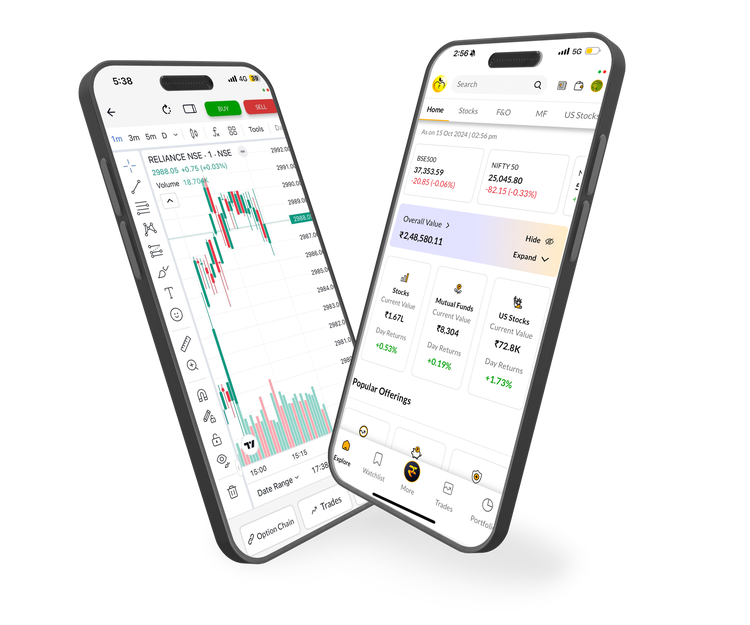
RIISE - Stock Market Investing App
Get access to real-time insights, research, and execute your trades at lightning speed with the new trading and investing App.
- Curated Collecion of Mutual Funds
- Easy Payment Options
- Scheme Details and Return Calculator
- Dynamic Report
- Track wealth in one place
- Free US stock accoun with 24/7 trading
AIF FAQs
Your Questions, Answered
What are mutual funds?
Mutual funds pool money from multiple investors and invest it in stocks, bonds, or other assets, managed by professional fund managers.
How can I invest in mutual funds?
You can invest through SIP (Systematic Investment Plan) or lump sum via a registered advisor or investment platform.
What is SIP in mutual funds?
SIP allows you to invest a fixed amount regularly (monthly/quarterly), helping in disciplined investing and wealth creation over time.
Are mutual funds safe?
Mutual funds are subject to market risks, but diversification and professional management help in reducing overall risk.
What is the minimum amount required to start?
You can start investing in mutual funds with as little as ₹500 per month through SIP.